
The Dominant Chord
- stacking another third on top of our diatonic chords will give us sets of chords of the seventh

- the most is important is that on the 5th scale degree
- this chord is the chord of the dominant seventh or dominant chord for short
- it has rules for resolution into the tonic chord
- 7th of the dominant → down one scale degree [like all dissonance] to the 3rd of the tonic triad
- 5th of the dominant → down/up one scale degree to the 3rd/fundamental of the tonic triad
- more frequently the latter
- 3rd of the dominant → up one scale degree [as leading tone] to the fundamental of the tonic triad
- fundamental of the dominant → leaps up fourth/down a fifth to the fundamental of the tonic triad
- it has rules for resolution into the tonic chord
- this chord is the chord of the dominant seventh or dominant chord for short
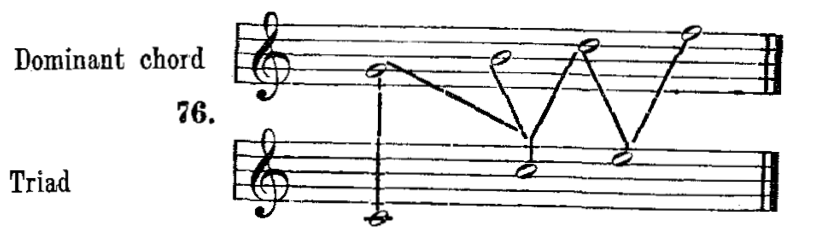
- with this type of voice leading the 5th is omitted from the tonic
- often the dominant has the 5th omitted
- rarely the third
- there are three inversions of the dominant chord
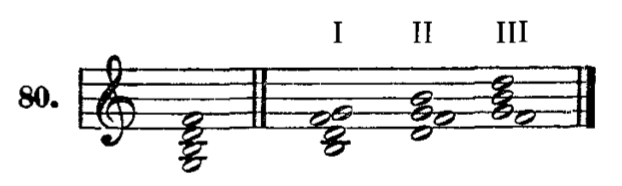
- I = chord of the sixth and fifth
- II = chord of the fourth and third
- III = chord of the second
- the one exception to the voice leading of these chords lies in the fact that the fundamental [G in this case] must remain stationary to complete the tonic triad
- leading of the 5th of the dominant can be led upward if necessary
- this will give rise to doubled third in the tonic
APPENDIX TO CHAPTER X
- special cases for voice leading
- dominant 7th lead to a chord of the sixth by the bass moving a m3 down
- always move the leading tone up to the tonic
- dominant 7th lead to a chord of the six four means the bass stays in the same position
- if there are two fundamentals then they must stay in the same voice
- the dominants 7th and 3rd can move oddly when they are in the inner voices
- contrary motion must still apply as they will otherwise lead to P5 or P8
- if the 5th is in the Soprano or Tenor voice in a dominant third inversion chord then it may leap a fourth up or a fifth down
- the faulty progression should be avoided
- don’t forget to double the fundamental of the dominant chord
- when in inversions – one can sometimes omit the 5th and double the fundamental
 Dane Madrigal