
The Connection of the Triads of the major scale
- Tchaikovsky wants us to write our harmony exercises in a four voice, choral format rather than block chords
- outer voices – soprano and bass
- inner [intermediate] voices – alto and tenor
- there are three positions that a chord can be in
- with the fundamental tone as the soprano – [position of the octave]
- with the third as the soprano – [position of the third]
- with the fifth as the soprano – [position of the fifth]
- at the moment we are only going to be dealing with what we now call closed voicings or keyboard voicings of chords
- another thing to keep in mind is that we will only be doubling the fundamental of the chord at the moment
- this is because we are not doing truly free voice leading
- we need to the voices to be as close as possible at the moment
- later, different chord tones can be doubled
- we need to the voices to be as close as possible at the moment
- doubling the fundamental in a chord, however, is the most natural and should be the aim
- this is because we are not doing truly free voice leading
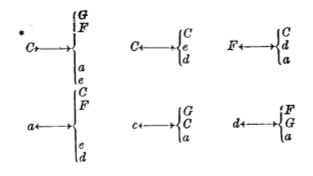
- chords will have external connections with one another in the form of common tones
- the diagram that Tchaikovsky gives for this is beneficial if one is to understand it; for a beginner in harmony this is difficult*
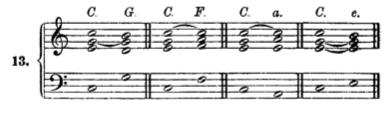
- to make triads connect as smoothly as possible, their common tones must be connected in the same voice
- the connections of common tones here are shown through the ties**
- meanwhile the bass is able to move freely, but the motion should be smaller rather than larger
- such as moving by a third rather than by a sixth
- Tchaikovsky’s Remarks:
- connect all the chords
- start on a lower voices tonic triad as it is easy to lead the voices too high
 Dane Madrigal