
The Harmony of the minor scale
- the harmony is built off of the harmonic minor scale
- this is for the leading tone which is needed for cadences
- will also create the interval of an A2 between scale positions 6+7
- melodic minor scale = not used in harmony
- only created in melodic situations to avoid the A2
- constructing chords from the minor scale will create 4 consonant chords
- 2 major – V and VI
- 2 minor – i and iv
- this is for the leading tone which is needed for cadences
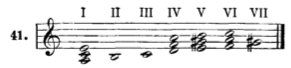
- the remaining chords will be dissonant
- 2 dimished
- 1 augmented
- Tchaikovsky says that there is less euphonious material to work with in minor than major
- we must address how to treat the dissonant chords as they need to resolve well
- in major [with the dim. chord] this was done with sequences
- this cannot be so in minor
- in major [with the dim. chord] this was done with sequences
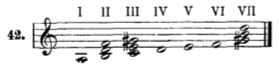
- the diminished triad on the seventh degree
- it has relations to chords built on 2,4,5
- however, it can only be properly connected with the triad built on 5
- this is because, if it were to be connected to one of the other triads, an A2 would rise out of the voice leading; this is a no go
- both common tones should stay in the same voice when leading from 5→7 or 7→5
- however, it can only be properly connected with the triad built on 5
- it has relations to chords built on 2,4,5
- the diminished triad on the second degree
- it has relations to chords built on 2,4,6
- only two things need to be avoided
- concealed octaves and fifths
- A2 in voice leading
- the A2 can easily be avoided when connecting 2→5 or 5→2 in contrary motion
- only two things need to be avoided
- it has relations to chords built on 2,4,6
- the augmented triad on the third degree
- it has relations to chords built on 1,5,6
- this chord is rarely used diatonically
- it finds many uses chromatically [or as an altered chord]
- it has relations to chords built on 1,5,6
- sometimes in using the leading tone in minor the chord that receives the resolution with have a doubled 3rd [this breaking the rule of doubling the root]
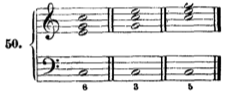
- figures bass is addressed here as it begins to become complicated
- 8 = position of the octave = first inversion
- 3 = position of the third = second inversion
- 5 = position of the fifth = root position
- if there is no figure bass marking then it is a triad in root position
- however, smooth voice leading takes president over this
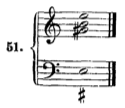
- accidents which stand alone are applied to the third of a chord, regardless of inversion
- if the accidental has a number to the right of it, then it applied to that pitch in the chord [here, it is the fifth to make an augmented triad]
 Dane Madrigal