
The Inversions of the Triad
- the fundamental is not always in the bass
- when it is another tone, this is called an inverted triad
- when the fundamental is put into another place in the chord this is an inversion
- every triad had 2 inversions !
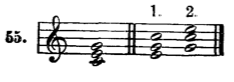
- the different inversions of the triad have different sonic properties
- the fundamental or root position triad contains a perfect consonance [P5]
- the french call this consonance “accord parfait”
- the inversions contain no perfect consonance
- therefore they are better suited for harmonic progression and movement
- they are found in the middle of a composition
- not often at the beginning
- never at the end
- they are found in the middle of a composition
- therefore they are better suited for harmonic progression and movement
- the fundamental or root position triad contains a perfect consonance [P5]
- doublings now begin to change due to inversion
- the 3rd of a chord is not sonorous
- therefore in a chord of the sixth [third in bass] the root or the fifth should be doubled
- this will lead to exceptional positions in voice leading
- doubling the third is not totally prohibited if it can be justified with good voice leading
- therefore in a chord of the sixth [third in bass] the root or the fifth should be doubled
- the 3rd of a chord is not sonorous
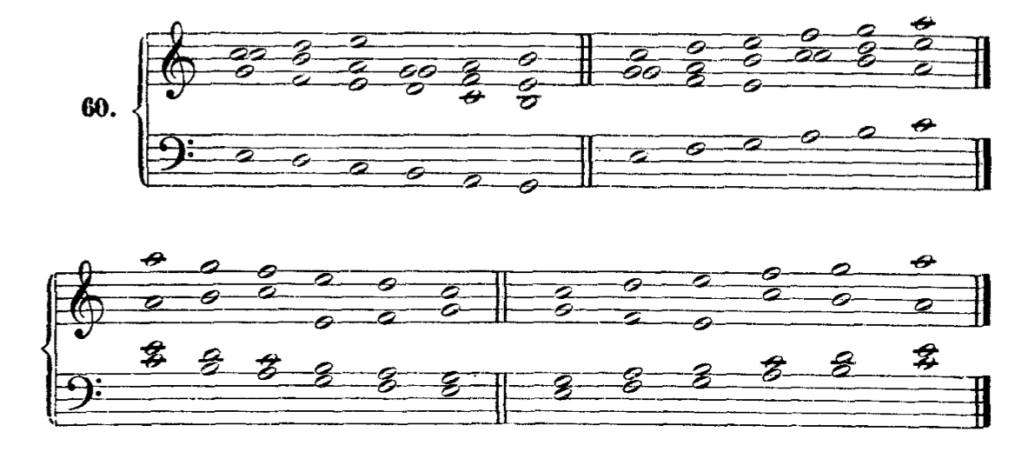
- chord of the sixth [first inversion] series
- this is the only type of inversion that can follow itself without poor voice leading
- best voice leading is as follows
- two of the voices should move in parallel with the bass while the other should be in contrary motion
- this is to create correct doublings
- two of the voices should move in parallel with the bass while the other should be in contrary motion
- best voice leading is as follows
- this is the only type of inversion that can follow itself without poor voice leading
- the third of a dominant chord leading to a tonic is to never be doubled [leading tone]
- a six-four chord [second inversion] should have its fifth doubled to avoid concealed octaves, which are common with and surrounding the chord
- [for later] the chord of the sixth is important for cadences
- concealed octaves and fifths need to be rooted out by keeping a clear mind to the fact that the positions of a triads need to constantly be changing
- these types of things can only happen when a motive demands it
- but even then, they must be present in the changing of motive, not in the motive itself
- these types of things can only happen when a motive demands it
- first inversion [the chord of the third and sixth] or [the chord of the sixth]
- second inversion [the chord of the sixth and fourth]
 Dane Madrigal