
Intervals

- lower tone = fundamental tone
- There are two groups that intervals can be classified into
- Group I
- major, minor, diminished, augmented intervals
- seconds, thirds, sixths, sevenths
- major, minor, diminished, augmented intervals
- Group II
- perfect, augmented, diminished intervals
- unisons (primes), octaves, fifths, fourths
- perfect, augmented, diminished intervals
- Group I
- This chart illustrates the different amounts of whole tones and semitones per interval (whole and half tones)
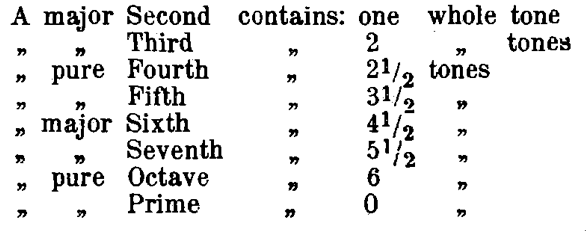
” = same word repeated downward
Naming Intervals
- From this information we are able to piece together the quality and quantity of intervals, as shown below
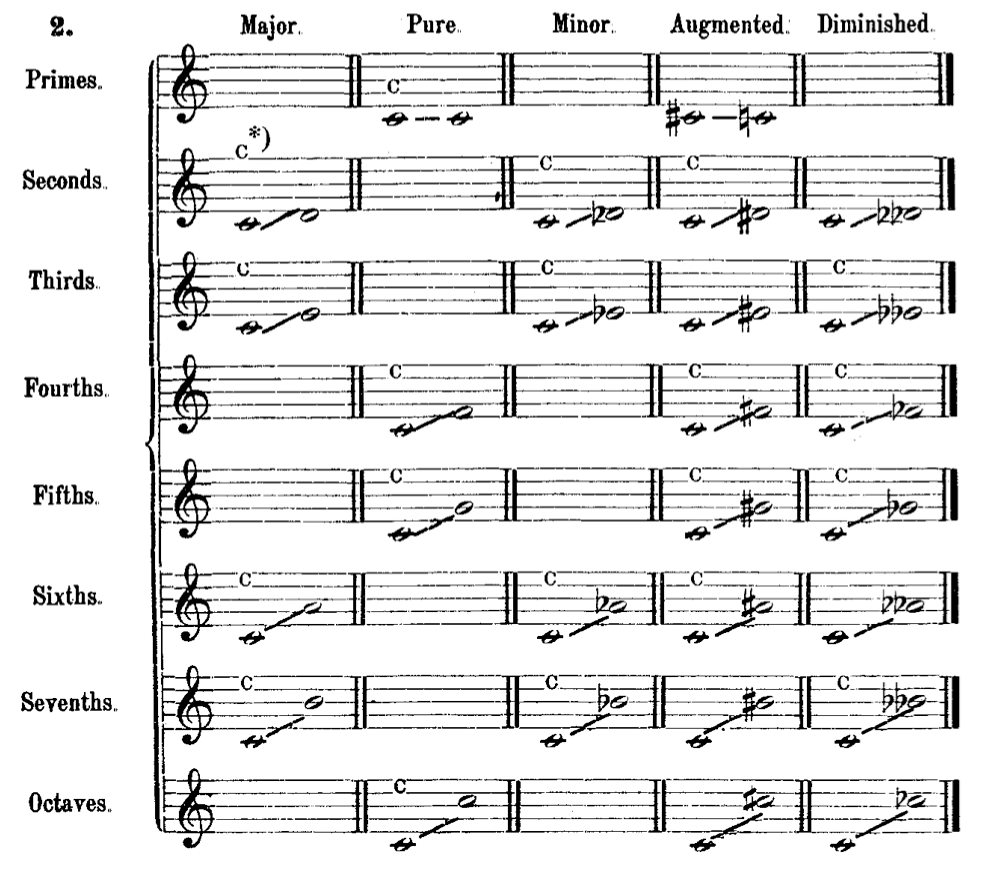
- quality – the type of interval
- major, minor, augmented, diminished, perfect
- quantity – the distance of the interval
- 1,2,3,4,5,6,7,8,9….
Inverting Intervals
Quantity
- When inverting intervals, the quality reverses and the quantity needs to add up to 9
- 1+8=9
- 2+7=9
- 3+6=9
- 4+5=9
- 5+4=9
- 6+3=9
- 7+2=9
- 8+1=9
Quality
- Perfect intervals remain perfect
- P5 → P4
- P4 → P5
- Augmented intervals become diminished intervals and visa versa
- A3 → d6
- Major intervals become minor and visa versa
- m7 → M2
Classifying Intervals
- Consonances
- P1, P8, P5, M3, M6, m3, m6
- Imperfect
- M3, M6, m3, m6
- Perfect
- P1, P8, P5
- Dissonances
- M2, M7, m2, m7, all diminished and augmented intervals
- P4
- depends on usage in music
- it is more inclined to be a dissonance
Harmony
- simultaneous concordance of musical tones
 Dane Madrigal