
The Inversions of the Diminished and Augmented Triads
- first inversion of the diminished triad is very important
- it is more commonly used than any of the other chords inversions
- it is the more common than the root position of this chord
- the reason for this is – the chord is essentially a consonant one
- from the bass, it forms a third and a sixth
- with the root position of this chord containing a diminished fifth, it simply cannot be employed in consonant harmony [therefore making a dissonant chord]
- the second inversion of the diminished chord is harsh – it is really only used in three part writing
- with the root position of this chord containing a diminished fifth, it simply cannot be employed in consonant harmony [therefore making a dissonant chord]
- from the bass, it forms a third and a sixth
- the reason for this is – the chord is essentially a consonant one
- how to connect the first inversion of the diminished chord to other chords in a key have two special cases
- when it precedes tonic
- in a diminished chord, the fundamental tone is also the leading tone – which must be lead upward
- thus, the leading tone cannot be doubled in four part writing
- the best alternative is to double the 5th, though sometimes the 3rd is doubled
- if the doubled 5th is above the leading tone in four part writing, then it must be lead downward to avoid forbidden progressions
- for this reason, we cannot voice a chord with two 5ths above the leading tone
- if the doubled 5th is above the leading tone in four part writing, then it must be lead downward to avoid forbidden progressions
- the best alternative is to double the 5th, though sometimes the 3rd is doubled
- thus, the leading tone cannot be doubled in four part writing
- in a diminished chord, the fundamental tone is also the leading tone – which must be lead upward
- when it precedes another triad of the scale
- diminished chords in first inversion before chords that are not the tonic can easily double the fundamental, as it no longer acts as the leading tone
- this is not how I understand harmony as the fundamental tone always is just that
- Tchaikovsky obviously views it differently in the context of a diminished chord in the first inversion
- what is more strange is that only one of his examples shows this
- Tchaikovsky obviously views it differently in the context of a diminished chord in the first inversion
- this is not how I understand harmony as the fundamental tone always is just that
- diminished chords in first inversion before chords that are not the tonic can easily double the fundamental, as it no longer acts as the leading tone
- when it precedes tonic
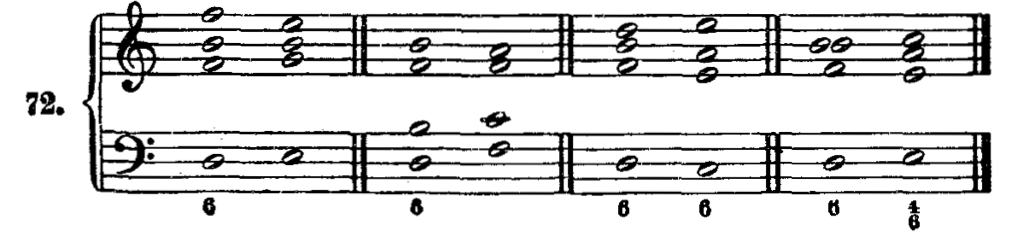
- when a diminished chord is in first inversion from the minor – the chord and the rules governing it fall into the general category of rules
- augmented chords
- in minor they are much too difficult to deal with at present – so they will be left for a later time
- in major they will be treated at present as a passing chord
 Dane Madrigal